
What If Nobody Noticed Your Name Was Wrong?
Leadership for a Better, Bolder, Brighter Teams:
AI Meets Ancient Wisdom & Transformative Methodology
Rúna’s blog series
For boards and leadership teams who want to understand what is being seen — but not said.
This blog explores how a seemingly small mistake — a wrong name repeated in leadership communication — reveals deeper patterns in listening, culture, and the invisible rules that shape behaviour within organisations.
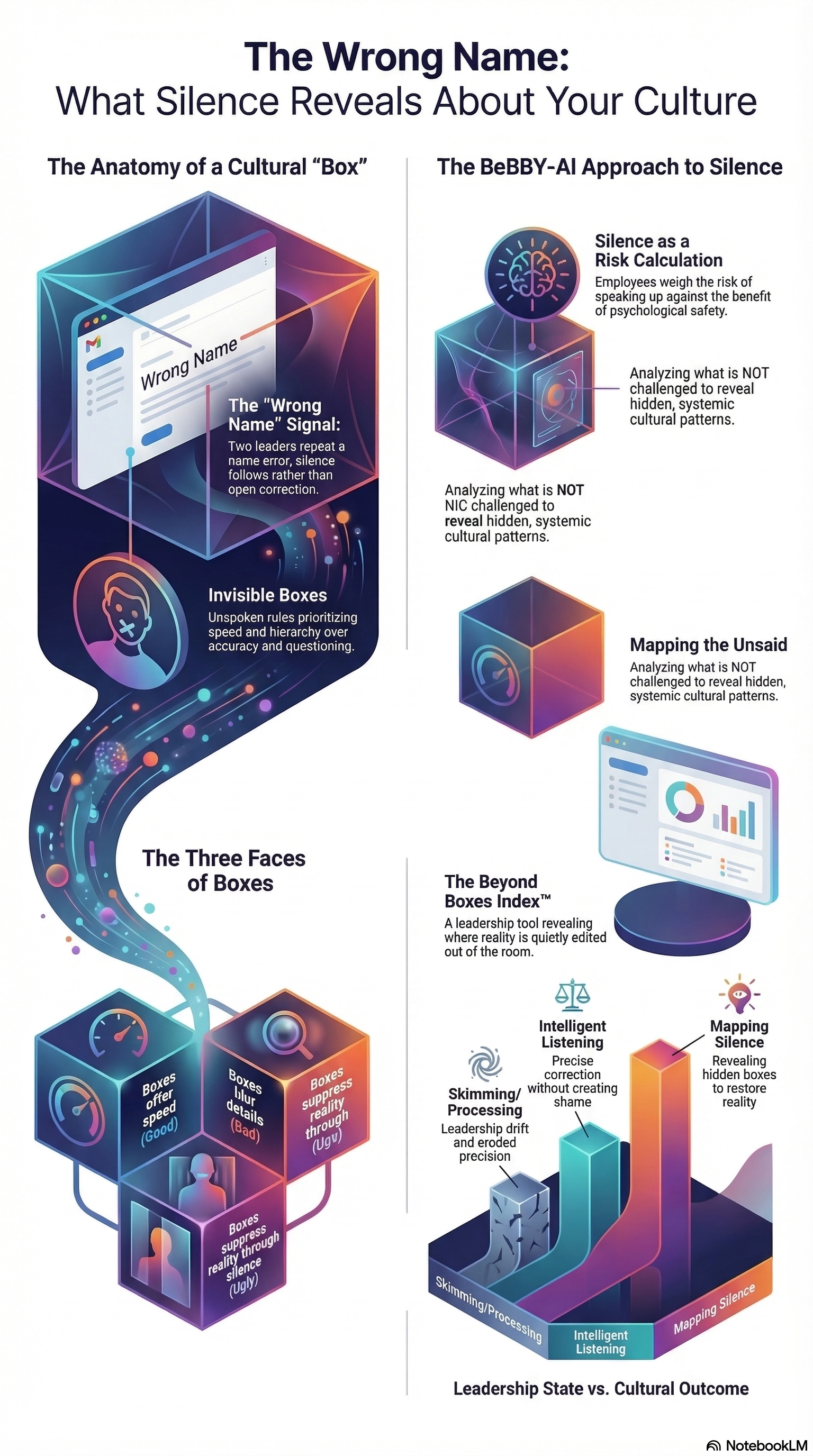
Through the lens of invisible “boxes” (the Good, the Bad, and the Ugly), it shows how speed, hierarchy, and silence can quietly distort reality in teams — and how leaders often lose connection not in big decisions, but in micro-moments of inattention.
It also introduces the foundation of BeBBY-AI and the emerging Beyond Boxes Index™, maps the invisible rules running your leadership — and shows you exactly what they are costing you and your organisation.
What If Nobody Noticed Your Name Was Wrong?
On listening, invisible boxes, and how silence quietly shapes leadership culture
A wrong name in two leadership emails isn’t a typo.
The first email arrived from the board chairperson. Formal. Official. Sent to everyone.
And somewhere in the middle of it — a board member's name. Wrong.
Not slightly off. Completely different name.
The second email followed shortly after. From the vice chair. Same situation. Same wrong name. Copied. Repeated. Reinforced.
And then — a third email.
No correction. No calling out.
Just the correct name. Used clearly. Intentionally. Almost elegantly.
Three emails. One name.
And a question that nobody asked out loud:
Did anyone actually notice?
The First Question Isn’t “How Did This Happen?”
The real question is:
Who noticed — and chose silence?
Because that’s where culture lives.
Not in what is said.
But in what is seen — and left unsaid.
Silence is not neutral.
Silence is data. And most leaders don’t like what it reveals.
Two Emails. Same Mistake.
One mistake is human. Forgivable. It happens.
Two identical mistakes — from two senior leaders — are something else entirely. That's not a typo. That's a pattern.
It tells you something quietly uncomfortable: the message was sent faster than it was read. The name was processed, not seen. The person behind the name wasn't fully present in the sender's mind.
We remember the names of people we truly see.
Everything else… we skim.
What Box Was This?
Most organisations don’t run on strategy.
They run on invisible boxes.
Unspoken rules like:
Don’t slow things down.
Don’t question upwards.
Don’t make small things “a big deal”
This is one of them.
And like all boxes — it has three versions:
The Good
The Good Box keeps things moving. Speed is respected. Hierarchy functions. Decisions get made.
The Bad
The Bad Box is where attention quietly drops. Assumptions replace awareness. Details blur because everyone is moving too fast to check.
The Ugly
The Ugly Box is where reality stops being corrected. People see things — and choose silence. Not out of malice. Out of calculation.
This wasn’t a typo.
This was a system working exactly as designed.
In my work, this is what I map as a “box”.
The Third Email
Someone noticed.
And chose to act — when everyone else chose silence.
And instead of correcting loudly — they corrected intelligently.
They restored the name.
No friction. No shame.
Without creating shame.
That’s leadership.
Not loud. Not performative.
Just… precise.
That person was listening — when the system had stopped.
Which makes the real question not who got it wrong — but why it took a third person to do what the first two could have done themselves.
What Happens in the Minds of Those Who Stayed Silent?
Silence is rarely indifference.
It’s a calculation.
Fast. Unconscious. Almost invisible:
“Should I say something?”
“Is this my place?”
“Will this land badly?”
“Is it worth it?”
And when the answer becomes “no” — repeatedly — you don’t get harmony.
You get suppressed reality.
That is the moment when psychological safety stops being a value and becomes a risk calculation. And once people start calculating whether it is safe to speak the truth, leaders begin to lose touch with what is actually happening around them. Not dramatically. Gradually. Quietly enough to miss until the distance is already significant.
It becomes a risk calculation.
Cultures rarely break.
They blur — slowly enough for leaders to miss it.
“It’s Just a Small Thing…”
Yes.
And that’s exactly why it matters.
Because culture is never built in big moments.
It’s built in the micro-moments where no one thinks it counts.
A name is not a detail.
A name is recognition.
And recognition is where trust begins.
What This Has to Do With Listening
We teach leaders to listen in conversations. To hear more perspectives. To invite challenge. To ask better questions.
But real listening starts earlier.
When you read before you send
When you pause before you assume
When you check before you copy
Listening is not a skill you turn on.
It is a state you either operate from — or you don't.
And most leaders don’t lose listening in meetings.
They lose it in speed. In the ten-second email. In the name, they copied without looking. In the detail they processed but never actually saw.
The Real Question
If you’re leading a board, a leadership team, or an organisation:
Where are your people noticing things — and choosing silence?
Because that is where your culture is already speaking.
What If?
What if you took one extra second before hitting send?
What if you asked:
“Am I actually seeing this person — or just processing them?”
What if the smallest details are not small at all…
…but the clearest signal of how you lead?
A name is the first listening test.
And the question is not just who got it wrong.
The question is:
Who saw it — and what did their silence tell you about the system you’re running?
It’s a signal — about how your organisation listens, what it tolerates, and which invisible boxes are quietly running the show.
→ Explore more What If reflections - https://runamagnus.com/whatif/
→ Or if you’re leading a team or board and want to see these patterns in real time: Let’s talk.
Reykjavík, Iceland, March 21st 2026

is a leadership coach, keynote speaker, and creator of BeBBY-AI — a conscious AI tool for self-awareness and reflective leadership. For boards and leadership teams who want to understand their patterns.
FAQ
-
Because they signal how much attention, respect, and presence leaders bring to people — and what the culture tolerates.
-
Unspoken rules that guide behaviour — like not speaking up, prioritising speed over accuracy, or avoiding challenge.
-
Repeated small mistakes, lack of correction, silence in meetings, and decisions made without challenge.
-
Most leaders don’t have a listening problem. They have a visibility problem.
The patterns are already there:
the same small mistakes repeating
things being noticed but not corrected
silence in moments that should invite challenge
The question is whether you can see them — early enough.
This is exactly what tools like BeBBY-AI and the emerging Beyond Boxes Index™ are designed to surface:
Not what people say in surveys.
But where reality is quietly being filtered, softened, or left unspoken.Because once you can see the pattern…
you can’t lead the same way again.
Personal branding, leadership and development books by Rúna Magnús

Beyond Gender: The New Rules of Leadership - GRAB COPY HERE!

The Story of Boxes, The Good, The Bad and The Ugly - GRAB YOUR COPY HERE!

Branding Your X-Factor - GRAB YOUR COPY HERE!