
The BeBBY Knowledge Library
A collection of essays exploring how AI can help us become more human, not less.
One question. One observation. One conversation at a time.
by Rúna Magnúsdóttir, Leadership Coach, Keynote Speaker & Founder of Beyond Boxes Index
________________________
Knowledge Paper
AI & Self-Awareness | #005
Your Team Already Has an AI Culture.
The question is whether you recognise it.
For a while, I thought I was having conversations about AI.
I wasn't.
One employee told me, "Our manager isn't comfortable using AI, so we're all waiting."
A manager admitted, "I'd love to explore AI. I'm too busy doing the work."
An HR director sighed. "Everyone loved the workshop. Three weeks later, not much had changed."
Different organisations. Same conversation. Nobody was talking about AI. They were talking about people.
That's when I realised I'd been asking the wrong question. Instead of "how do we get people to use AI," maybe the real question is "what happens when something new challenges the way a team already thinks?" That's the conversation I kept walking into. Not an AI problem. A human one.
The Culture Was Already There
I've started to think; perhaps we get AI backwards.
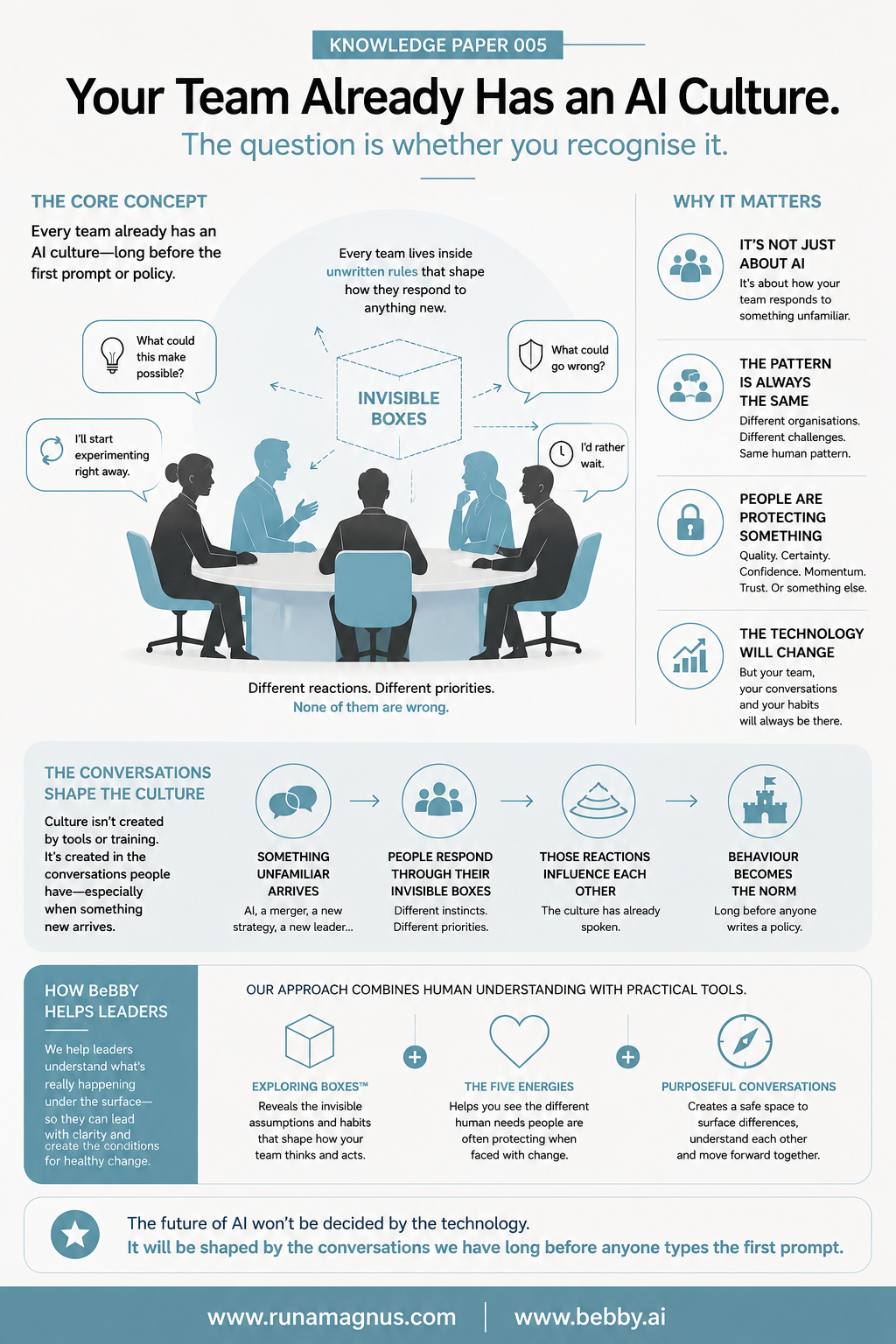
We spend a lot of energy asking how to build an AI culture, as if it doesn't exist yet. I don't think that's true. Every team already has one — long before the first prompt, long before the workshop, long before someone writes a policy nobody will read.
Every team already lives inside assumptions, habits and unwritten rules that shape how people respond to something new.
One person asks what this could make possible. Another asks what could go wrong. Someone starts experimenting immediately. Someone else waits. Neither is wrong. They're just protecting different things. And without anyone noticing, those individual reactions start shaping each other, until the culture has already spoken before the meeting even begins.
Around the Same Table
Put five people around a table to discuss AI, and you'll probably get at least 5 opinions. One wants to start yesterday. Another wants to wait until everything is certain. Someone asks for evidence. Good luck getting those two to agree before lunch. Someone else asks why you're still talking about it. I've met teams where everyone agrees AI matters, and somehow nobody uses it. Human beings are wonderfully creative like that.
The interesting part was never who's right. It's what each person is trying to protect. Once I started paying attention to that, the conversation changed. Not for them. For me.
It Was Never Really About AI
After a while, I stopped listening to what people were saying and started listening to what they were protecting. One person was protecting quality. Another was protecting certainty. Someone was protecting their team's confidence. Someone else was protecting momentum.
The conversation sounded like it was about AI. It rarely was.
I've lost count of how many times I've heard someone described as resistant to AI. I've become suspicious of that label. Resistant to AI, or protecting something important? They're not always the same thing. Once I started asking that question, people made a lot more sense.
The Pattern I Couldn't Unsee
After enough of these conversations, I stopped hearing different stories. I kept hearing the same one, wearing a different outfit each time.
Every team's invisible boxes show up the moment something unfamiliar arrives, whether the unfamiliar thing is AI, a merger, a new CEO or a change in strategy. What looked like an AI problem in one organisation was a trust problem in another, and a confidence problem in a third. Same pattern. Different disguise. The technology was never the variable that mattered.
The Conversation Worth Having
These days, I ask teams a different question. Not "are you ready for AI," but "what happens in your team when something unfamiliar arrives?"
Because AI will change. The next technology will arrive, and the one after that. But every new challenge will meet the same team, the same boxes, the same instinct to protect what matters most to each person in the room.
The organisations that get this right won't be the ones with the best AI policy. They'll be the ones who've done the harder work of knowing what their people are protecting, and helping them protect it out loud instead of in disguise.
Perhaps the future of AI won't be decided by the technology.
It will be shaped by the conversations we have long before anyone types the first prompt.
Part of The BeBBY Knowledge Library
A collection of essays exploring how AI can help us become more human, not less.
One question. One observation. One conversation at a time.
Reykjavík, Iceland, July 27th 2026

Rúna Magnúsdóttir (aka Runa Magnus) is a global keynote speaker, leadership coach, and creator of Beyond Boxes Index™ — a Leadership Energy Intelligence diagnostic exploring how culture, pressure, and unconscious social “boxes” shape the way we lead, behave, and see ourselves.
BeBBY Definition
The Leader's Mirror™
A reflective partner that helps leaders notice patterns, assumptions and the mental boxes through which they interpret themselves, other people and the world. The Leader's Mirror™ does not replace human judgement. It strengthens reflection, creating greater awareness and more intentional choices.
Part of The BeBBY Knowledge Library
A collection of essays exploring how AI can help us become more human, not less.
One question. One observation. One conversation at a time.
Continue exploring:
The BeBBY Questions™
Every Knowledge Paper is one piece of a much larger conversation.
These are some of the questions we're exploring across The BeBBY Knowledge Library.
Questions connected to this paper:
-
Many people assume the difference is about technology.
It usually isn't.
Teams don't all respond to AI in the same way because they don't all respond to change in the same way.
Every team already has its own habits, assumptions and unwritten rules. Some people naturally see new possibilities. Others instinctively look for potential risks. Some prefer to experiment. Others prefer certainty before taking the first step.
None of these reactions is wrong.
They're simply different ways of responding to uncertainty.
That's why introducing AI isn't just about teaching people how to use new tools.
It's about understanding how your team already responds when something unfamiliar enters the room.
Once leaders recognise those patterns, conversations about AI become far more productive.
Because the challenge was never just the technology.
It was understanding the people using it.
-
The better question might be whether you need to create one at all.
Every team already has an AI culture.
It exists before the first AI workshop, the first prompt, or the first policy.
It's reflected in how people respond to something new.
Do they become curious or cautious?
Do they experiment or wait?
Do they openly discuss concerns or quietly avoid the conversation?
Introducing AI doesn't create those behaviours.
It simply makes them more visible.
That's why building a healthy AI culture starts with understanding your team's existing culture.
The technology matters.
But the conversations people have about the technology matter even more.
The strongest AI cultures aren't built by introducing better tools.
They're built by creating an environment where people feel safe to explore, question, learn and adapt together.
-
People are rarely resisting AI itself.
More often, they're protecting something that matters to them.
For one person, it might be confidence.
For another, quality.
For someone else, trust, security or the fear of making an expensive mistake.
That's why labelling people as "AI resistant" can be misleading.
The same person who appears resistant today may become your biggest advocate once their concerns have been acknowledged.
Successful AI adoption isn't about convincing everyone to think the same way.
It's about creating conversations where different perspectives can be understood before they're judged.
When leaders become curious about what people are protecting, resistance often becomes easier to understand.
And once people feel understood, they're usually far more willing to explore something new.
-
Many organisations assume the biggest barriers are the technology, the budget or the training.
Sometimes they are.
More often, the challenge is human.
People don't all respond to change in the same way.
Some are eager to experiment.
Others need more certainty before taking the first step.
Some worry about quality.
Others worry about keeping up.
If leaders only focus on the technology, they often miss the conversations happening underneath it.
Successful AI adoption isn't just about introducing new tools.
It's about recognising the human patterns that shape how people respond to those tools.
The organisations that adapt most successfully aren't always the ones with the best AI strategy.
They're often the ones that understand their people best.
-
Many AI initiatives focus on teaching people how to use new tools.
At BeBBY, we start somewhere else.
We begin by helping leaders understand how their team already responds to uncertainty, change and new ideas.
Through the Exploring Boxes™ methodology, leaders learn to recognise the invisible assumptions and habits that shape everyday conversations and decisions.
The Five Energies add another layer of understanding by revealing the different human needs people are often protecting when faced with change. One person may seek certainty. Another freedom. Another understanding. Another quality. None of these responses is wrong, but they can easily create misunderstanding if they're not recognised.
Only then do we bring AI into the conversation.
Because AI doesn't create those patterns.
It simply gives them another opportunity to appear.
When leaders recognise the patterns first, AI becomes far easier to introduce.
Not because people suddenly think the same way.
But because they begin to understand why they think differently.
Part of The BeBBY Knowledge Library
A collection of essays exploring how AI can help us become more human, not less.
One question. One observation. One conversation at a time.
Personal branding, leadership and development books by Rúna Magnús

Beyond Gender: The New Rules of Leadership - GRAB COPY HERE!

The Story of Boxes, The Good, The Bad and The Ugly - GRAB YOUR COPY HERE!

Branding Your X-Factor - GRAB YOUR COPY HERE!